One account, three ways to sell
Distinction supports three different products under a single account and a single wallet. They share your login but not their fees, because each one delivers something different to the buyer. Choosing the right one up front keeps your pricing clear and your buyers happy.
A course is lessons, progress, and assessments. You create it on Create and sell online courses, keep up to 97% of each course sale (processing separate), and follow the how-to in How to create an online course with AI. A digital product is a download — an ebook, guide, template, or workbook — sold on Sell digital products, where AI can draft the file, cover, and sales page and a store fee applies when someone buys. Lecture notes are past questions, lab reports, slides, and handouts for classmates, sold on the student store, where listing is free and the same store fee applies on a sale.
If what you are selling is a ticket, a hoodie, or a booking, that is outside what Distinction is built for, and a marketplace made for merchandise and events will serve you better.
Deciding by what the buyer receives
The quickest way to choose is to ask what actually arrives after payment. If it is modules, a quiz, a certificate, and a place on a roster, it is a course. If it is a PDF or a zip the buyer keeps, sold to a wide audience, it is a digital product. If it is a pack another student needs for a specific course code, it belongs on the student store.
A couple of cases sit slightly further along the same path. A school on your own domain, with many courses and learner management, is a branded academy — and academy enrolments still use the course fee, not the store fee. A parent paying in pounds for GCSE or 11+ tuition is best served by UK tuition centre software. And a stranger simply browsing public lessons starts on the learners hub, which is discovery rather than a seller page.
It also helps to know that a syllabus without video is still a course — generate the outline first and add Video Studio where a lesson needs a clip. An outline without a file is a digital product waiting to be built. A growing set of notes only becomes a course when you publish it as one on Create and sell online courses.
Keeping the fees separate
Courses and academies keep up to 97%, with processing separate; that rate does not extend to ebooks or notes. Store products carry a published per-sale fee, explained in How Distinction pricing works. Lecturer plans are separate again, so check lecturer pricing rather than assuming the course rate.
If you are also weighing other platforms, those are software choices rather than a fourth Distinction product — see Teachable vs Distinction and Distinction, Kajabi, and LearnWorlds.
Growing across products
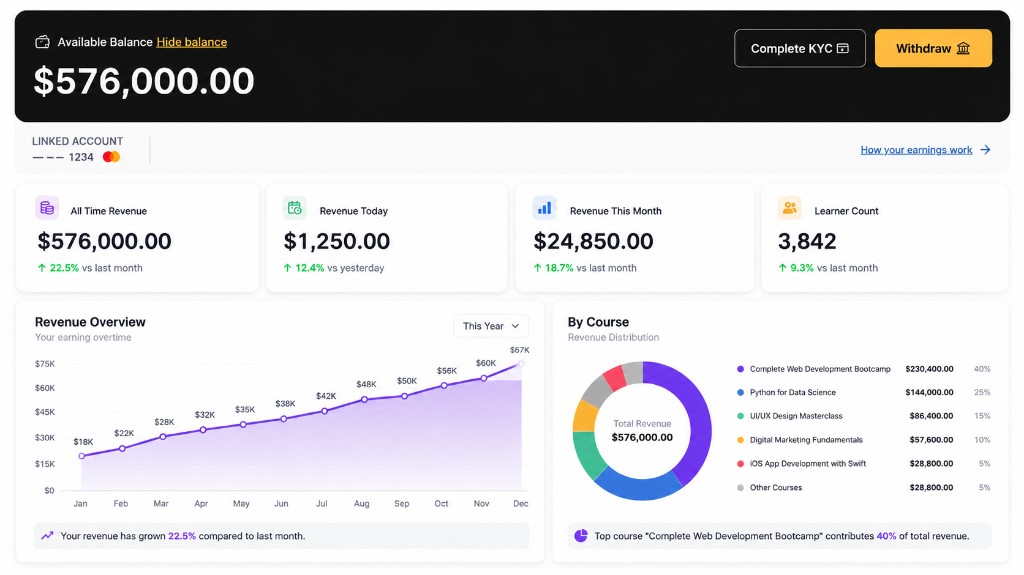
Many people start with notes, move on to a longer PDF, then build a course, and eventually run an academy on their own domain. Distinction holds that whole journey under one login. Your identity verification and wallet are shared; only the fee line changes with each product, so a course sale and a notes sale in the same week will settle on different models. Withdrawals across all of them are covered in How payouts work.
When two products genuinely belong together, sell them as two clear listings with two prices and say so on each page. That is far easier for a buyer to understand than a single listing trying to be both a school and a download. If you later fold notes into a course, publish the course on Create and sell online courses and retire or relabel the old file so no one pays twice for the same thing.
How to pick, in a few steps
- Write one sentence for what the buyer receives after they pay.
- If it is a ticket, merchandise, or a live seat, this is the wrong platform.
- If it is progress, modules, and an assessment, use Create and sell online courses.
- If it is notes for one course code sold to classmates, use the student store.
- If it is an ebook or template for a wide audience, use Sell digital products.
- If it is a branded school on your domain, use Launch a branded academy — still on course fees.
- Quote "keep up to 97%" only for courses and academies; files use the store fee.
- Create the listing on that product, complete verification once, and expect two wallet shapes if you sell both models.
One product, one page, one fee, one promise — that is what good looks like, and it is what makes the next sale easy to explain.
Frequently asked questions
I have PDFs and a video curriculum. Which URL?
Video curriculum is a course (/creators). A standalone PDF workbook is a digital product (/sell). Lecture-note PDFs for students are /student-store.
Can I quote 97% on /sell?
No. 97% is course/academy only.